

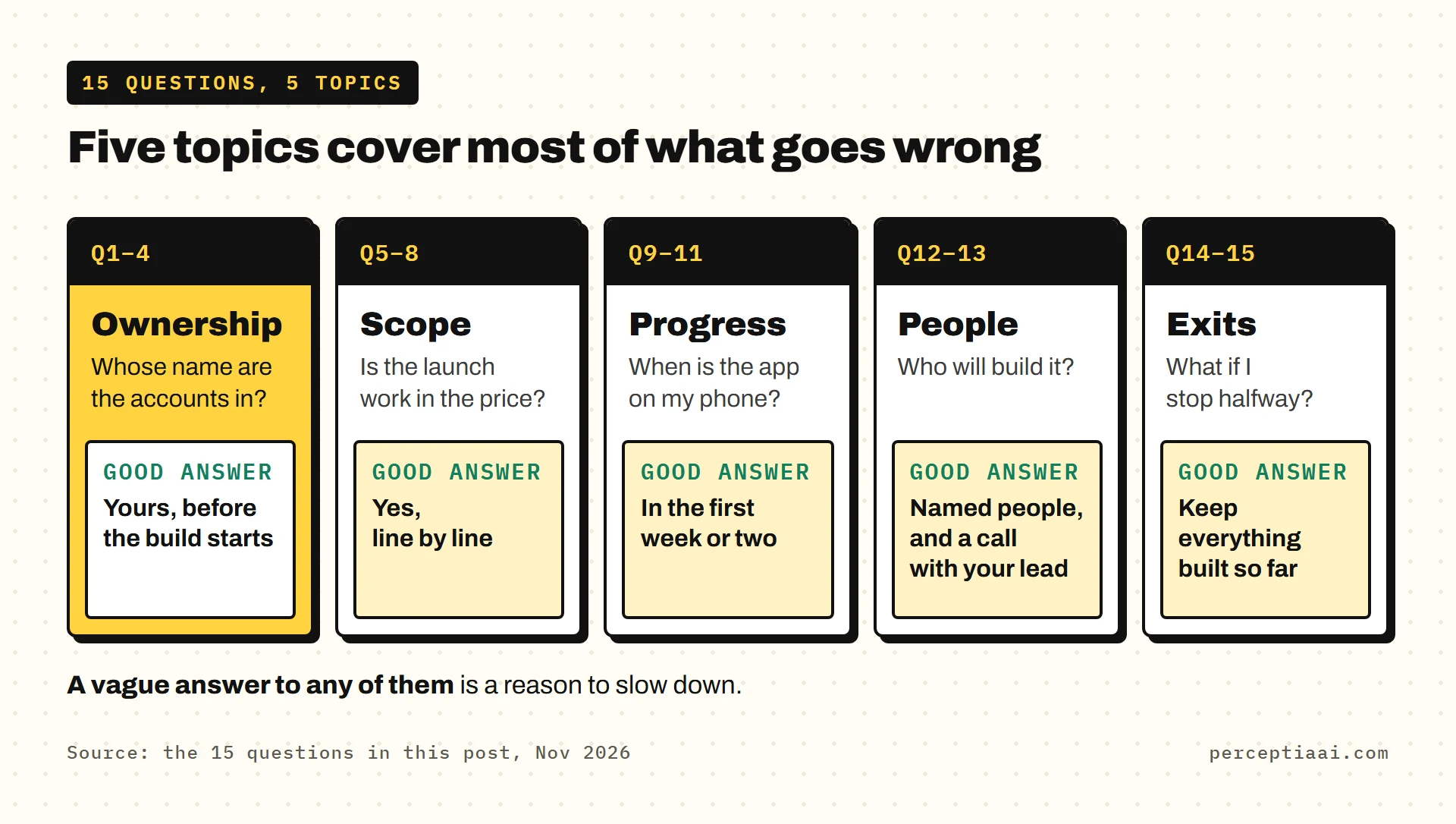
Before you sign with an app developer, ask who will own the code and accounts, what launch work is in the price, how you'll see progress, who will actually build it, and what happens if you stop halfway. Those five topics cover most of what goes wrong on app projects, and a good developer answers all of them plainly.
A vague answer to any of them is a reason to slow down.
I take the first calls and do the pricing at PerceptiaAI, so I'm the person these questions get asked of here. Use them with any developer, including us. If I could only ask one, it would be number 1.
The work a quote leaves out
Most people who commission an app aren't developers, so they judge progress by demos and dates. That's fair enough. The trouble is that a quote usually lists features, not the work that decides whether the app can go live.
In our review of fixed-price app packages, not one mentioned account deletion or a privacy policy, though Apple and Google require both. Apple's own App Review page says "over 40% of unresolved issues are related to guideline 2.1: App Completeness".
My reading of those two facts: the expensive surprise isn't a missing feature, it's an app that's "finished" and can't launch. The questions below bring that hidden work into the open before you pay.
Ownership: who holds the code and accounts
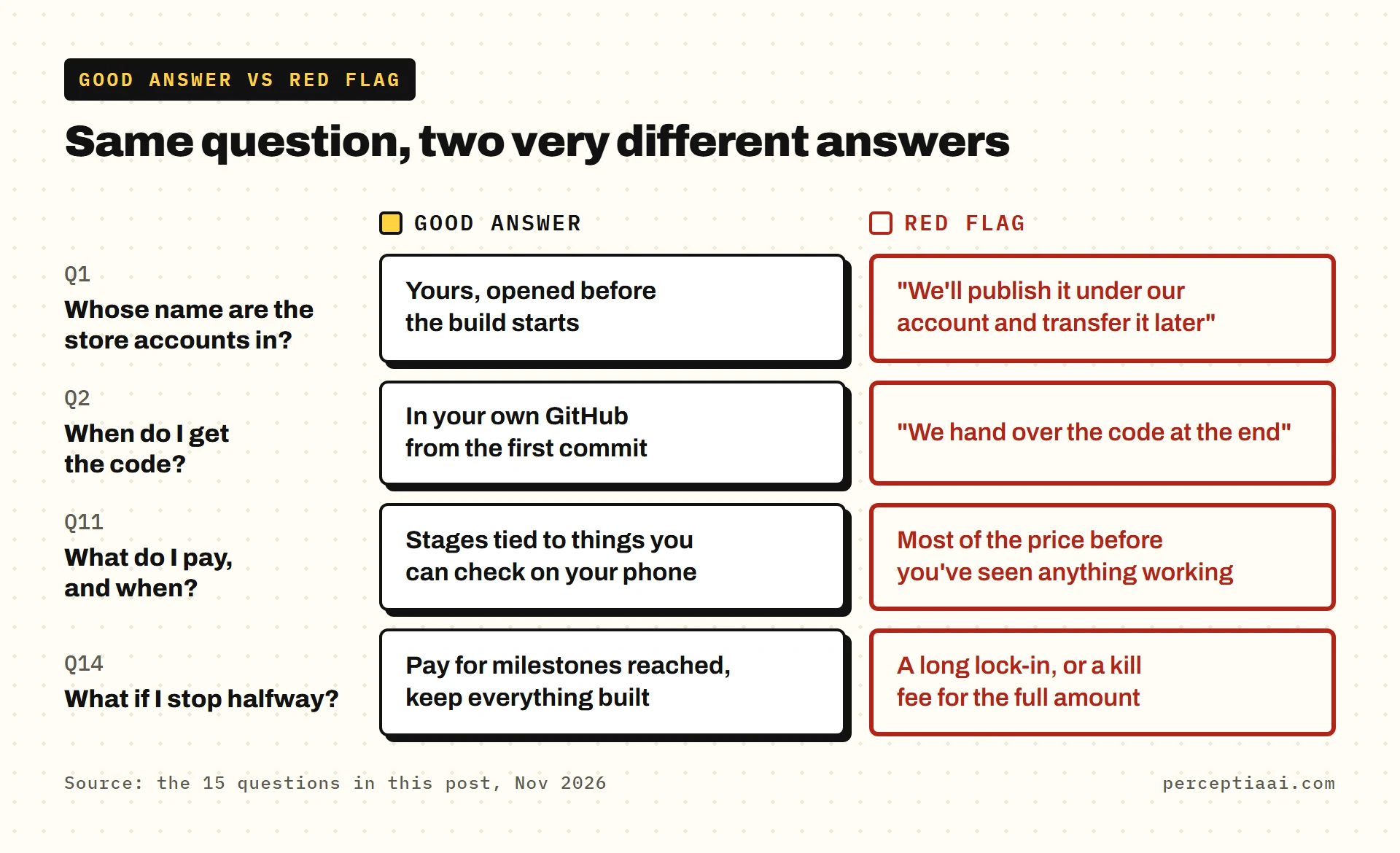
1. Whose name will the App Store, Google Play, database and domain accounts be in? Good answer: yours, opened before the build starts. Red flag: "We'll publish it under our account and transfer it later."
2. Where will the code live, and when do I get access? Good answer: in your own GitHub (or similar) from the first commit. Red flag: "We hand over the code at the end."
3. When does ownership of the code pass to me? Good answer: as each milestone is paid, written into the contract. Red flag: no answer, or "when the project is complete."
4. If another developer had to take over, what would they get? Good answer: a handover pack with setup steps, an account list and release steps. Red flag: "Nobody else would understand our code."
This is the section I'd never skip. If the accounts and code aren't yours, the other eleven answers matter less.
If you've already been through the bad version of this, our page on what to do when a developer abandons your app covers recovering code and accounts.
Scope: what's actually in the price
5. Can I see the full list of screens? Good answer: yes, before you sign, including the standard ones like settings and password reset. Red flag: a feature list with no screens.
6. Is the launch work included: privacy policy, account deletion, store listings, submission to both stores? Good answer: yes, line by line. Red flag: "That's usually extra" or "You'll handle the store side."
7. Is there an admin dashboard, and what can I do in it without a new app release? Good answer: a specific list (users, orders, content, reports). Red flag: "We can add one later."
8. What's not included? Good answer: a written list, such as content writing, store fees and hosting. Red flag: "Everything's included."
Question 8 is the easy one to forget. Without a written list of exclusions, you can't compare two quotes fairly.
Progress: how you'll see it's real
9. When will I first have the app on my own phone? Good answer: in the first week or two, then regularly. Red flag: "At the end of the design phase" with no date, or only screen recordings.
10. How will you report progress? Good answer: a set rhythm, such as a weekly test build and a written update. Red flag: "We'll keep you posted."
11. What do I pay, and when? Good answer: stages tied to things you can check, such as a working core flow on your phone. Red flag: most of the price before you've seen anything working.
Of the three, I'd weigh question 9 most. A build on your own phone shows the app works; a screen recording mainly shows that someone owns a phone.
People: who's really building it
12. Who will build my app, and can I talk to them before I sign? Good answer: named people, and a call with your lead. Red flag: you only ever meet sales.
13. Where is the team, and what hours will overlap with mine? Good answer: a straight answer, with the overlap hours written down. Red flag: a vague "global team" or an office address that doesn't check out.
Since we're asking you to ask this, here's ours: our team is in Sialkot, Pakistan. You meet the people building your app before you sign, and the hours you can reach your lead are written into the contract.

The exits: what if it goes wrong
14. What happens if I want to stop halfway? Good answer: you pay for the milestones reached, keep everything built so far and get a proper handover. Red flag: a long lock-in or a kill fee for the full amount.
15. What happens if Apple or Google rejects the app? Good answer: if it's the developer's code, they fix it at no charge, and there's a period of free fixes after launch. Red flag: "Rejections are outside our control."
Neither question is pessimistic. A developer with a calm, specific answer to both has thought about it before you asked.
Red flags in an app quote
Even before the call, a quote can tell you a lot. Watch for:
- A feature list with no screen list
- No mention of privacy policy, account deletion or store submission
- No admin dashboard, or one described as 'basic' with no detail
- Store and code accounts set up on the developer's side
- Most of the price due before you see a working build
- No list of what's excluded
- Case studies you can't find in the stores or confirm with the client
- A price far below everyone else with the same scope listed
How to use these questions
Send the list, with your filled-in app requirements document, ahead of the first call, then compare answers side by side. The cheapest quote that answers all fifteen well is a better deal than the cheapest quote. For the wider process, including how to check a developer's case studies, read how to choose an app development company.
If you do one thing this week, I'd email question 1 to every developer on your list before booking any calls. The written answers will tell you who's worth calling.
Our answers to all fifteen
Ask us too. Our own answers are on the how we work page.