

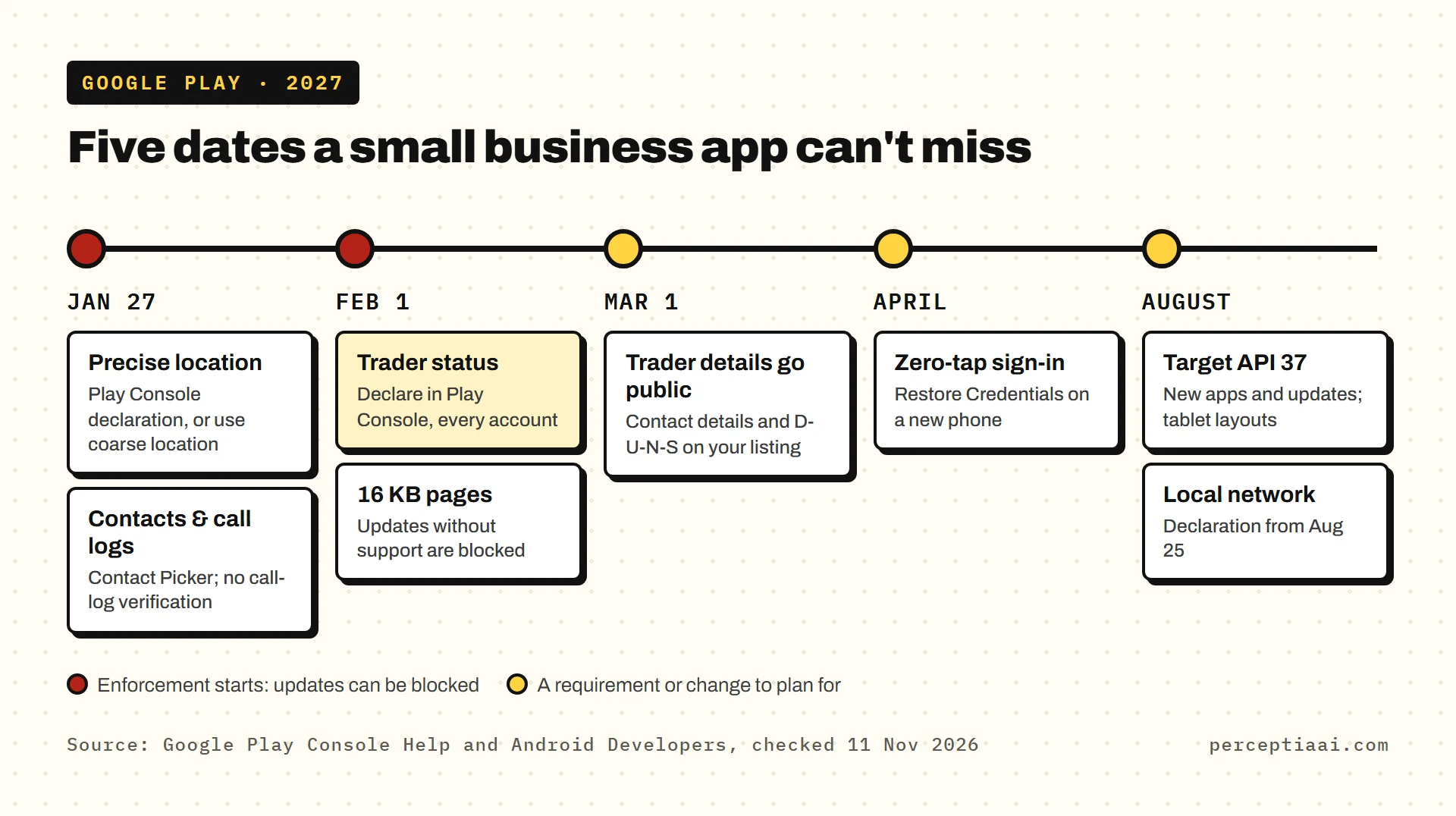
Between now and the end of 2027, the Google Play deadlines most likely to hit a small business's app are: new location and contacts rules on January 27, 2027; trader status and 16 KB memory pages on February 1; memory limits in February; zero-tap sign-in on new phones in April; and target API level 37 in August 2027.
None of these is hard on its own. What I'd worry about is the count: five dates between January and August, and most of them need a new build. If I had to pick one to start on today, it's zero-tap sign-in, because it's the only one that needs work on your server as well as the app.
Every date here is one we could confirm on Google's own pages, checked on 11 November 2026, with the fix for Flutter and React Native apps alongside.
Every Google Play deadline, November 2026 to December 2027
| Date | What changes | What to do | Flutter / React Native fix |
|---|---|---|---|
| December 1, 2026 | Apps selling into or out of Japan need a payments authorization | Complete the authorization form | None |
| January 27, 2027 | Precise location needs a declaration; API 37 apps use the location button for one-off requests | Use coarse location, or declare precise | Check the merged manifest for ACCESS_FINE_LOCATION; a plugin can add it |
| January 27, 2027 | Broad contacts access restricted | Use the Android Contact Picker | Swap a full contacts plugin for a picker |
| January 27, 2027 | No phone-call verification with READ_CALL_LOG; no geofencing in foreground services | Use SMS Retriever; use the Geofence API | Remove any plugin that adds READ_CALL_LOG |
| January 27, 2027 | Student-style discounts must disclose eligibility and later pricing | Add the wording to your paywall | Text only |
| February 1, 2027 | Trader status declaration due for every account | Declare in Play Console | None |
| February 1, 2027 | Updates without 16 KB page size support blocked (apps targeting Android 15+) | Rebuild native libraries 16 KB-aligned | Upgrade the framework and plugins that ship .so files |
| February 2027 | Memory thresholds; 25% DEX optimization above 10 MB of DEX | Check Android vitals and the app bundle explorer | Flutter: R8 on by default. React Native: set enableProguardInReleaseBuilds to true and test |
| March 1, 2027 | Trader details shown on listings | Check your listing | None |
| April 2027 | Sign-in restored on a new phone via Restore Credentials (games exempt) | Add Restore Credentials | Native Android module plus server work |
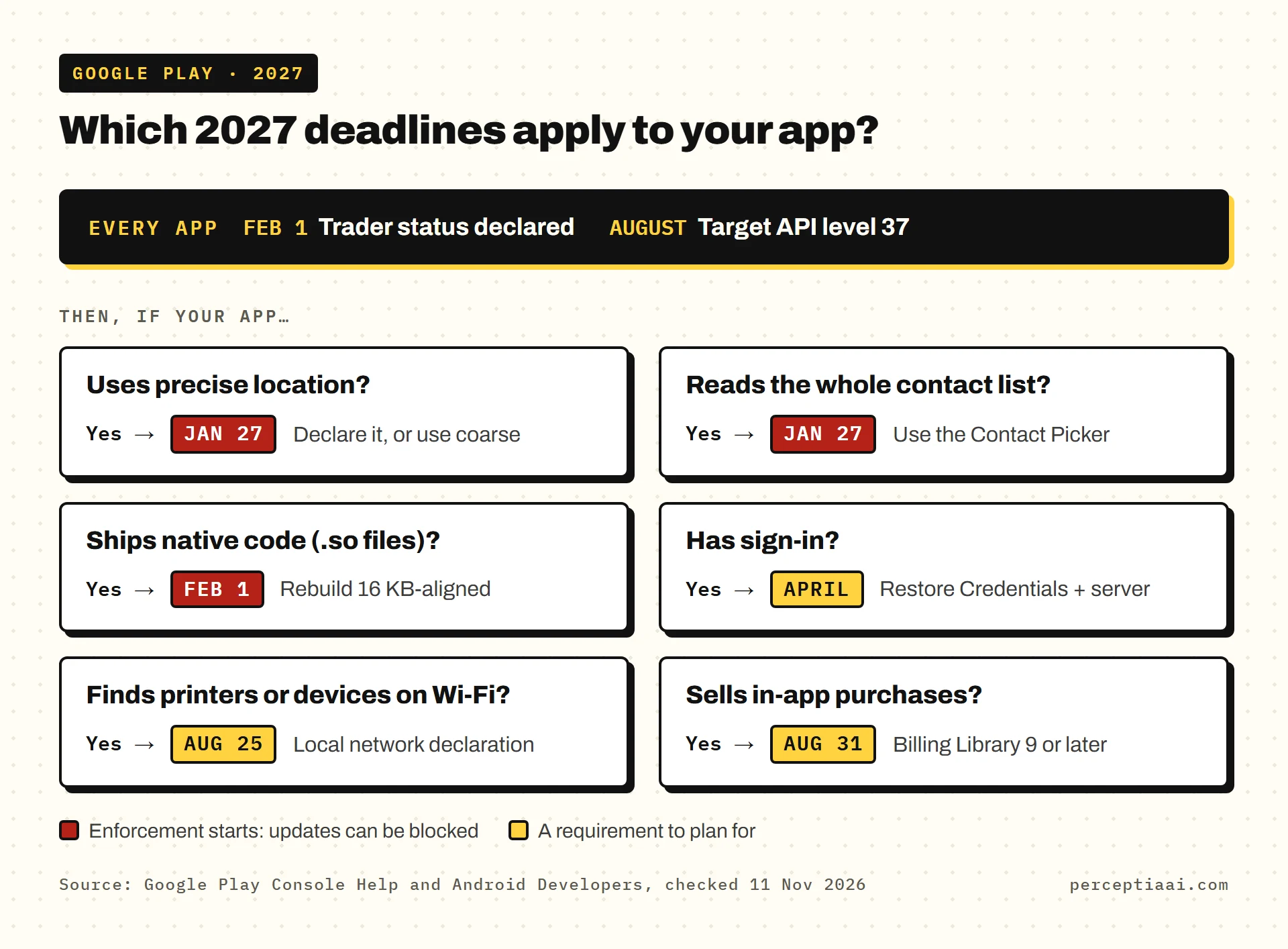
| August 2027 | New apps and updates target API level 37 | Raise the target, test on tablets | Portrait locks from SystemChrome.setPreferredOrientations or Expo's orientation are ignored on tablets |
| August 25, 2027 | Local network and Manage Contacts permissions need declarations | Use device pickers, or declare | Check Wi-Fi printer and discovery plugins |
| August 31, 2027 | Billing Library 8 deadline (extension to November 1) | Move to version 9 or later | Update in_app_purchase, RevenueCat or react-native-iap |
| 2027 | Developer verification goes global | Confirm every app is registered | None |
The Japan row comes from Google's October 29, 2026 policy announcement: "If you sell into or out of Japan, you must complete authorization by December 1st, 2026, or your payments will be held globally." If you don't sell in Japan, skip it.
Target API level: 36 now, 37 in August 2027
Google's Target API level requirements help page sets two floors, starting August 31, 2026:
- "New apps and app updates must target Android 16 (API level 36) or higher to be submitted to Google Play".
- "Existing apps must target Android 15 (API level 35) or higher to remain available to new users on devices running Android OS higher than your app's target API level."
The extension to November 1, 2026 has now run out. If your live app still targets API 34 or lower, new users on phones running a newer Android version can't find it.
The next step up is dated in an Android Developers Blog post from February 13, 2026, Prepare your app for the resizability and orientation changes in Android 17: "For Google Play, new apps and updates will be required to target API level 37, making this behavior mandatory for distribution in August 2027." Google hasn't named the day. The last two deadlines, for API 35 and API 36, both fell on August 31.
The catch for business apps is what "this behavior" means. At API level 37, Android ignores orientation and resizability locks on large screens (smallest width of 600 dp or more), games excepted. A portrait lock stops working on a tablet, so this is the change I'd test earliest: try your screens on a tablet and a foldable before you raise the target.
January 27, 2027: location, contacts and call logs
These come from Google's Policy Deadlines page and the permissions policy preview. The first two are the ones a business app is likeliest to touch:
- Location: "Apps targeting Android 17 (API 37+) must use the Android location button for one-time or infrequent location requests. To use ACCESS_FINE_LOCATION, you must submit a Play Console declaration justifying why coarse location or the location button is insufficient."
- Contacts: "Broad access to users' contacts is now restricted. If your app does not require broad access for its core functionality, you must use the more secure Android Contact Picker."
Both point the same way: use the system's own button or picker, and only declare when you need more. The next two are narrower:
- Call logs: "on January 27, 2027, account verification via phone call will no longer be a permitted use case for the READ_CALL_LOG permission" (October 29, 2026 announcement).
- Geofencing: "We're removing geofencing as an approved foreground services use case. Developers can instead use the Geofence API for this use case."
If nobody on your team added READ_CALL_LOG on purpose, check that a plugin didn't add it for you. The last one is about wording, not code:
- Subscriptions: "Subscriptions with ongoing eligibility-based discounts, such as student plans, must clearly disclose eligibility criteria, the verification process, and post-eligibility pricing and benefit changes."
A delivery or field service app needs precise location, so file the declaration. A booking app that only shows the nearest branch can usually use coarse location instead.
February 2027: 16 KB pages, memory and code size
Android's page sizes guide says that apps targeting Android 15 and higher "must support 16 KB memory page sizes on 64-bit devices on Google Play. Starting February 1, 2027, if your app updates don't support 16 KB memory page sizes, you won't be able to release these updates." Anything that ships compiled native code has to be rebuilt for it.
That's a hard block on updates, which is worse than it sounds: the next urgent bug fix is the one that won't go out.
The memory rules come from Google's August 26, 2026 post, Elevating app quality: "Starting in February 2027, apps and games must meet their respective bad behavior thresholds for Memory usage (Anonymous RSS + Swap), Bitmap memory usage and DEX code optimization." Apps that don't "may see reduced app visibility and publishing capabilities on Google Play."
The detail I'd check first is in Google's technical quality requirements: the 25% code-optimization rule "will only be enforced where you have non-negligible DEX sizes", which Google sets at more than 10 MB of DEX code for apps. A Flutter app's own code is compiled Dart, not DEX, so check the app bundle explorer first. Flutter's release guide says R8 "is enabled by default when you build a release APK or AAB". React Native's template ships with enableProguardInReleaseBuilds = false, so shrinking stays off until you turn it on.
February 1 is also the deadline for Google Play trader status, including what your listing shows from March 1.
April 2027: zero-tap sign-in on a new phone
The same August 26 post sets the standard: "The Zero-Tap Sign-In standard will require any app supporting user sign-in, optional or mandatory, to automatically restore a user's sign-in state when they move from one Android device to another with the Android Restore Credentials API." And the date: "Starting in April 2027, Google Play will require apps to meet the Zero Tap Sign-In requirement to maintain full publishing capabilities and optimal visibility in the Play Store." Games are exempt for now.
I think this is the biggest change on the list for most business apps.
Google's Restore Credentials guide recommends it for apps with passkeys "because of the common underlying server-side implementation". That phrase is the warning. Plan native Android code and a change to your login server, not a plugin update, and book it before the summer work on API level 37 starts.
August 2027: Android 17 declarations and billing
Three more dates arrive with Android 17 and the billing library:
- Local network: "Apps targeting Android 17 or higher (API 37+) must submit a Play Console declaration to use this permission" (from August 25, 2027, per the Policy Deadlines page). This hits apps that find printers or other devices on the Wi-Fi.
- Manage Contacts: the policy preview says "Apps targeting Android 18 or higher (API 38+) must submit a Play Console declaration to use this permission", effective the same day.
- Billing Library: Google's deprecation table lists version 8 with a new app and update deadline of "August 31, 2027" and an extension deadline of "November 1, 2027". Since "new apps and updates must use supported versions", an app selling in-app purchases needs version 9 or later for its next update after that date.
If your app sells in-app purchases, I'd fold the billing upgrade into the API 37 release rather than ship it on its own.
Already in effect: three 2026 changes worth knowing
These aren't deadlines any more, but they still apply:
- Account transfers. Since the April 15, 2026 policy update, Google says: "You must use the official account transfer process; we prohibit the sale, lease or purchase of accounts through third-party marketplaces or illegitimate means" (Account Transfers policy). Moving one app uses the separate app transfer process, which matters if a former developer still holds your app.
- App registration. Google's July 15, 2026 announcement says "99% of apps on Play have been registered automatically"; check Play Console Home for the rest "to avoid global removal from Google Play". Developer verification "will be expanded globally for all apps on certified Android devices in 2027."
- Fees. From June 30, 2026, in the US, EEA and UK, "the service fee starts at 10% on your first $1M (USD) in annual earnings", including "all auto-renewing subscriptions", plus a 5% billing fee when Google Play's billing is used (Android Developers Blog).
A 2027 plan for a small business app
- Now: trader status declared, every app registered in Play Console
- Before January 27: location declaration filed; unneeded contacts and call-log permissions removed
- Before February 1: an update with 16 KB-aligned native libraries
- February: memory and DEX numbers checked in Android vitals
- Before April: Restore Credentials shipped, with the server change
- By early summer: a build targeting API level 37, tested on a tablet
- Before August 31: purchase plugin on Billing Library 9 or later

For the rules both stores check on launch day, see the app launch checklist. For a yearly budget, see what app maintenance costs.
If you only do one thing this week, open Play Console and check two things: that trader status is declared, and that every app shows as registered. Neither needs a developer, and Google's wording for both includes the word "removal".
How we keep up with it
Keeping up with this table is what App Care is for. Every plan, from App Care Lite at $129 a month, covers new iOS and Android versions, store-rule changes and security patches, so target API levels and policy changes are handled before they become a deadline. If we didn't build your app, an App Check comes first.
Changelog
- 2026-11-11: Published. Checked against Google's Policy Deadlines page, the target API level and trader status help pages, and the Android Developers Blog posts of February 13, June 24 and August 26, 2026.