

An app like Uber costs anywhere from a few thousand dollars for a fixed package to well over $300,000 for a full platform, and the gap is almost entirely scope. Agency estimates put a focused, single-city version with rider and driver apps, live tracking and payments at about $75,000 to $150,000 (Chop Dawg), with other agencies quoting a basic version from about $40,000 to $60,000 (Cleveroad). A first version for one fleet or one town, cut to the core trip, can cost far less.
I do the pricing at PerceptiaAI, so here's my view up front: Uber itself is not something any fixed package can build. It isn't what you need on day one either.
What you can build is a first version that does the core job for your riders, your drivers and you, and then grows.
The parts of an app like Uber
Every ride-hailing or on-demand app has the same building blocks. Knowing them helps you read any quote.

| Part | What it does | Why it costs |
|---|---|---|
| Rider app | Request a ride, see the fare, track the driver, pay, rate | Many screens, maps, payments |
| Driver app | Go online, accept jobs, navigate, complete trips, see earnings | A second app with its own flows |
| Dispatch | Matches a request to a driver | The logic is simple to describe and hard to get right |
| Live tracking | Driver location on the rider's map, updated as they move | Real-time data, battery use, background location |
| Payments | Card payments, receipts, refunds, driver payouts | Money rules, provider set-up, edge cases |
| Admin dashboard | Drivers, trips, prices, refunds, reports | Usually under-scoped in cheap quotes |
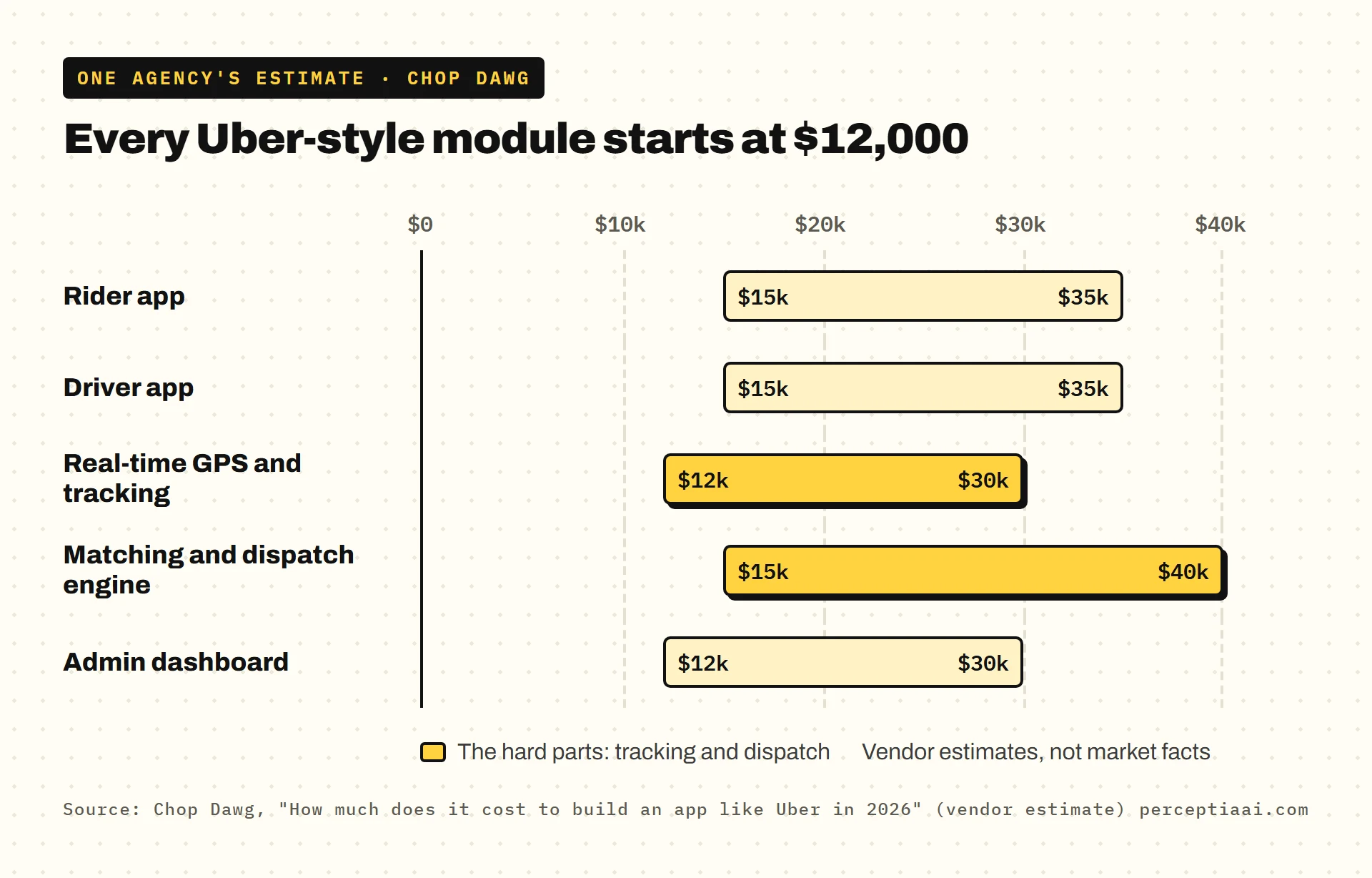
Chop Dawg's module breakdown gives a sense of agency pricing: $15,000 to $35,000 each for the rider and driver apps, $12,000 to $30,000 for real-time GPS and tracking, $15,000 to $40,000 for the matching and dispatch engine, and $12,000 to $30,000 for the admin dashboard. These are one vendor's estimates, not market facts, but the shape is typical: the hard parts are tracking, dispatch and payments.
If a quote looks cheap on those three lines, that's where I'd ask questions first.
Why fixed "Uber clone" packages are so cheap
You'll also find taxi app packages and white-label scripts for a fraction of agency estimates. In our own review of published fixed-price app packages (October 2026, a small sample of five taxi and ride packages), the standard tiers had a median price of $3,249 and the advanced tiers a median of $6,499, ranging from $3,999 to $9,800. One white-label script sold for $999.
Those prices are real, but check what's in them. In the wider set of packages we reviewed, not one mentioned account deletion or a privacy policy, both of which Apple and Google require. One $9,800 taxi tier excluded store upload entirely.
A cheap clone that can't get through review isn't cheap.
What a realistic first version looks like
A first version should prove the trip works for real riders and real drivers in one place. That means:
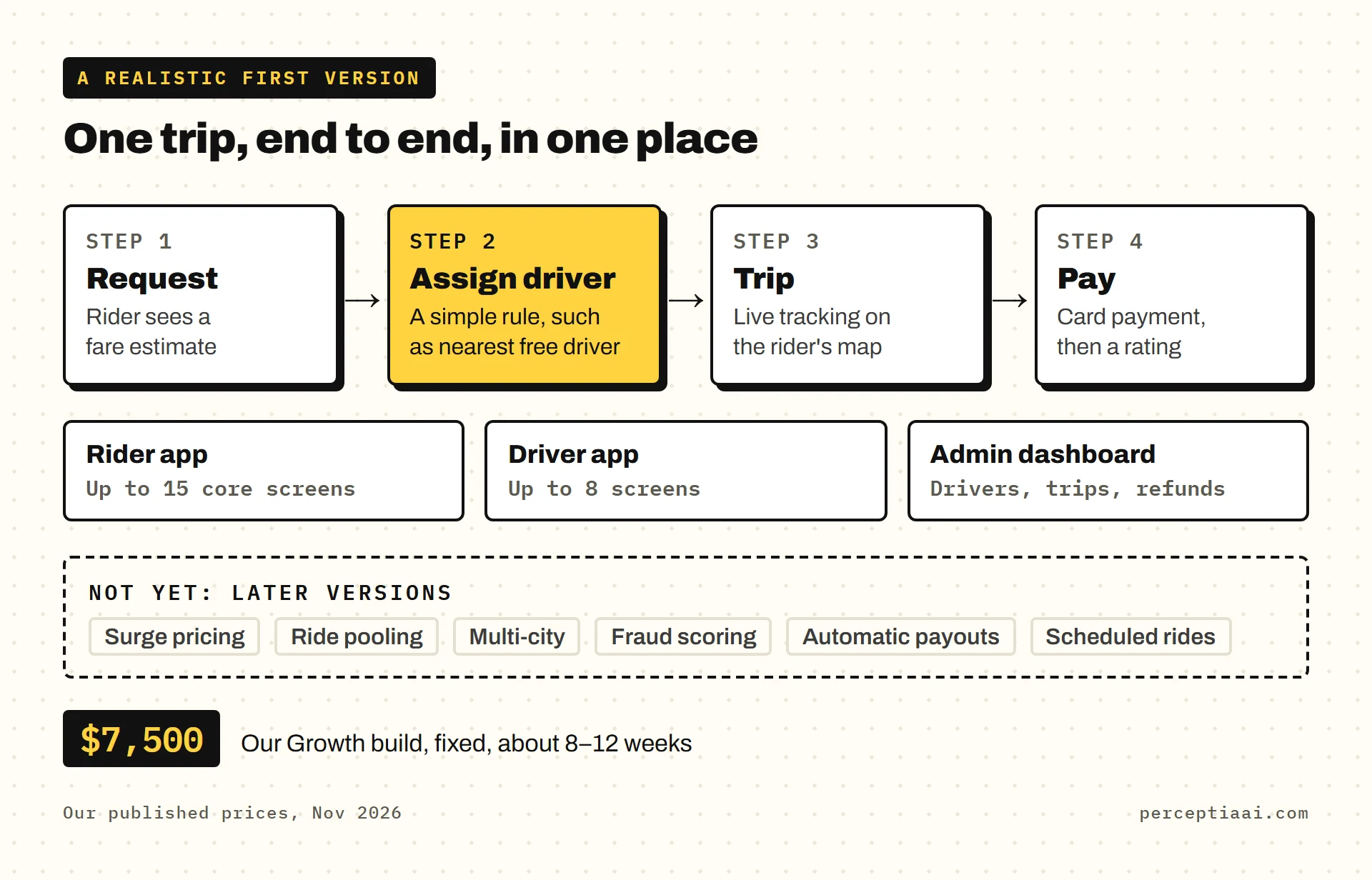
- In: sign-up for riders and drivers, request a ride, a fare estimate, assigning a driver, live tracking, card payment, trip history, ratings, an admin dashboard to manage drivers and trips.
- Not yet: surge pricing, ride pooling, multi-city operations, fraud scoring, automatic driver payouts, promo engines, scheduled rides.
If I were scoping your ride app, I'd expect the "not yet" list to be the harder conversation. Every item on it is a real feature, and none of them is needed to prove a rider can get from one address to another. Surge pricing, for a start, needs a surge.
That cut is what most agencies call an MVP. It's also the scope where a fixed price becomes possible.
How that maps to our Growth tier
At PerceptiaAI, a rider app plus a driver app plus an admin dashboard is a Growth build: $7,500 fixed, about 8–12 weeks, paid in five stages. Here's how a first ride app fits:
| Growth includes | For a ride app |
|---|---|
| Customer app, up to 15 core screens | The rider app |
| A second app or web portal, up to 8 screens | The driver app |
| One connected flow per side | Request → assign driver → trip → pay |
| Two ways to get paid | Card payments plus, for example, subscriptions for regular riders |
| Two big features | Live map tracking and in-app chat |
| A bigger admin with team roles and reports | Drivers, trips, refunds and reports |
| The launch kit | Store listings, privacy pages, account deletion, submission to both stores |
Dispatch in a first version is a simple rule you agree on the screen list, such as the dispatcher assigns jobs, or the nearest free driver gets the offer first. A smarter matching engine is a later version.
Add-ons you might need
Prices are fixed and come from our add-on list:
- Live location tracking: from $990, if you'd rather spend Growth's two big features on something else, such as chat and a link to a system you already use.
- Map and places (address search, saved places): $290.
- Extra sign-in method, such as a phone code: $99.
- Link to an outside API, for example a driver document check service: $390.
- Extra language: $149 each. Arabic right-to-left layout: $249.
- Extra screen: $149 each.
If the list grows to three or more apps (for example a separate fleet-owner portal), multi-city rules, or heavy system links, it's no longer a Growth build. That's a Custom build, quoted in writing after a free call.
What's not included
A fair quote says what it leaves out. Ours leaves out:
- surge pricing, ride pooling, scheduled rides and promo codes beyond the agreed screens;
- automatic split payouts to drivers (many first versions pay drivers from the admin's trip report);
- fraud detection and advanced driver vetting;
- operating in several cities with different prices and rules;
- content writing;
- Apple's developer fee ($99 a year) and Google's ($25 once), hosting (usually about $0–45 a month at launch), and the usage fees your map and payment providers charge, all paid in your own accounts;
- local licensing for taxi or private-hire work, which is yours to check where you operate.
Three things I'd ask for before paying
Whoever you hire, ask for three things before you pay for the build: the full screen list for both apps, how dispatch will work in plain words, and a list of what's excluded. If a quote can't give you those, the price doesn't mean much yet.
If you do one thing this week, write down how a driver gets a job in your business today, in one plain sentence. That sentence is the start of your dispatch rule, and it's the part of any quote I'd want to see first.
For the wider picture, see our guide to app development cost, and if you're moving parcels or food rather than people, read about delivery app development. Our two-sided apps page covers the customer-plus-driver build in more detail.